

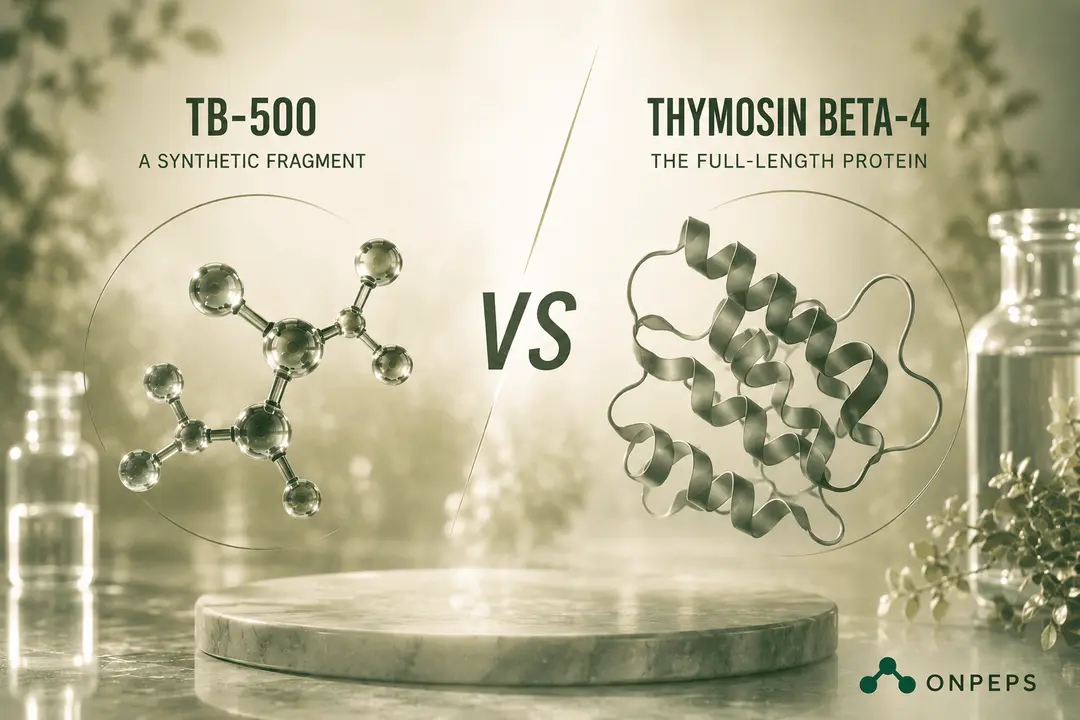
TB-500 and thymosin beta-4 are not the same molecule. TB-500 is a synthetic seven-amino-acid fragment of full-length thymosin beta-4 (Tβ4), and almost all clinical evidence in the literature belongs to the intact 43-amino-acid protein, not the fragment users inject.
Basic differences
Item Thymosin Beta-4 (Tβ4) TB-500
Structure Full 43-amino-acid protein Synthetic 7-amino-acid fragment
Molecular weight ~4,921 Da 889.0 Da
Source Naturally occurring in the body Laboratory synthesized
Human clinical data Multiple studies Zero
Why this matters
TB-500 is roughly one-sixth the molecular weight of full-length Tβ4. Because TB-500 is much smaller, it may be absorbed, distributed, broken down, and interact with cells differently — but these differences have not been fully studied.
The logic behind creating TB-500
Scientists believed they could isolate the actin-binding part responsible for healing and cell movement, creating more stable and easier-to-make peptides. Research is still ongoing as to whether it offers the same benefits.
What human studies say
The evidence usually cited in support of TB-500 comes mainly from full-length Tβ4, not the synthetic fragment. TB-500 has not been tested in human clinical trials.
Conclusion
“Clinical evidence for thymosin beta-4” and “clinical evidence for TB-500” are not interchangeable, even though they’re treated that way across most of the market. Understanding this distinction is the first step toward a rational assessment of TB-500.