

What Are Peptides? From 2 Amino Acids to 50, Explained Clearly
Overview
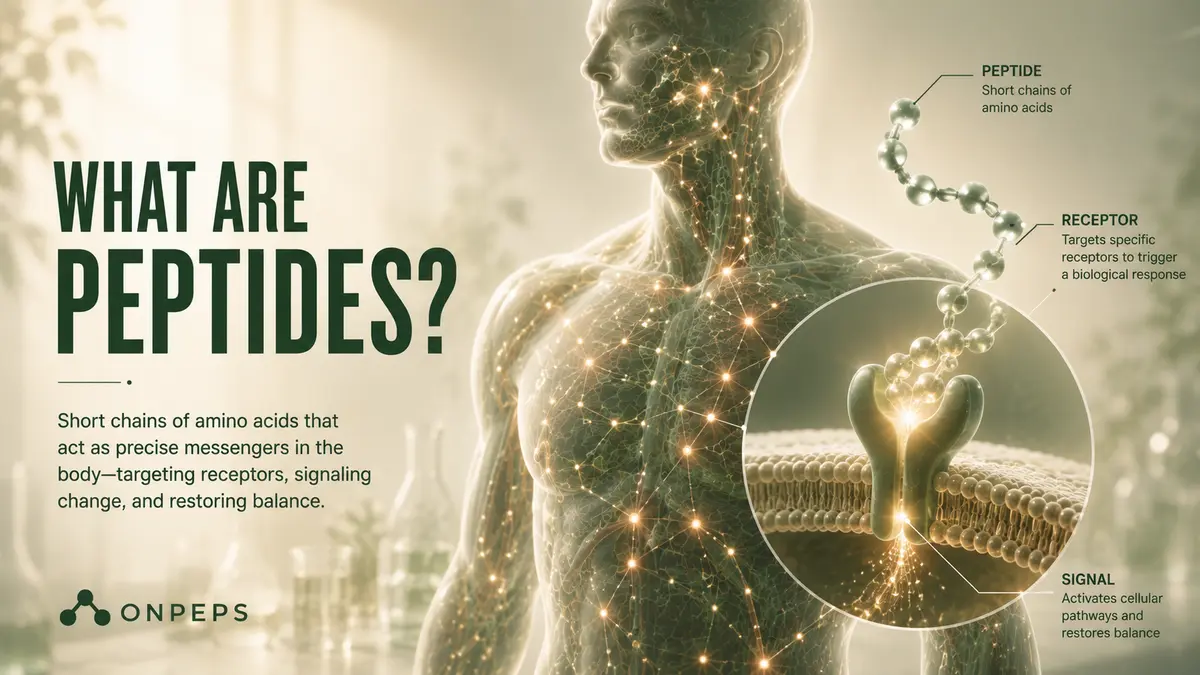
Peptides are short chains of amino acids that act as precise signals in the body. They can influence metabolism, recovery, and cellular function. Understanding the definition, structure, and classification of peptides is the first step toward understanding their role in metabolism, growth, and cell communication.
This article starts from the most basic definition and gradually explains how peptides are built, how they are formed, how they are classified by chain length, and the key concepts associated with them.
1. What Is a Peptide?
According to research (Forbes Kaprive et al., National Institutes of Health), peptides are defined as short chains of amino acids. They act as key biochemical regulators of a wide range of biological activities in the human body.
Specifically:
Peptides are short chains of 2–50 amino acids linked by peptide bonds.
They can be formed through ribosomal synthesis within cells or manufactured in the laboratory by chemical methods.
Their structure allows them to bind to receptors and modulate biological processes.
Amino acids are the starting units that make up living organisms. Each amino acid contains a carboxyl terminus and an amino group. These two components form the basis of the entire structure.
2. What Are Peptides Made Of?
Basic Structure of Amino Acids
Each amino acid contains a carboxyl terminus and an amino group. The C-terminus is essentially the tail end of the peptide chain. Because proteins are assembled amino acid by amino acid, it is the last amino acid added to the peptide chain.
The C-terminus is not just a transit point. It determines the peptide's transport route in the body, how long it lasts before being broken down, and how it actually exerts its effects.
How Peptide Bonds Form
Amino acid molecules are joined together through a specific condensation reaction. This chemical process causes a water molecule to be permanently removed from the molecular structure.
The remaining portion of each amino acid is called a residue. It is called a residue because it is the only part left after the dehydration reaction occurs. This reaction forms a peptide bond, which determines the stability and rigidity of the final structure.
3. Physical Properties of the Peptide Bond
Research (Forbes Kaprive et al., National Institutes of Health) shows that the resulting peptide bond is very stable. This linkage has partial double-bond character, making it rigid and preventing the molecule from rotating freely.
This rigidity is actually a major advantage. It allows the peptide to maintain the specific shape it needs to bind to receptors in the body, like a key fitting into a specific lock. Without this fixed structure, the peptide would be too flexible to function effectively.
The specific connection between two amino acids is called a covalent bond. It forms within the active site of the ribosome. This linkage has partial double-bond character. A double bond is shorter and structurally stronger than a normal single bond. Breaking it requires more free energy.
This structural strength gives the linkage extremely high heat resistance and resistance to high concentrations of urea. As a result, the bond is rigid and planar. Steric hindrance from R groups ensures that it is almost always in the trans configuration.
This physical structure limits complete free rotation between the carbonyl carbon atom and the nitrogen atom. However, bonds between other carbon atoms in the sequence can rotate freely. This allows the entire molecule to adopt multiple structural configurations.
4. How Are Peptides Classified by Chain Length?
Naming depends strictly on the exact number of residues in the sequence. As more units are added to the primary structure, the chain continues to extend.
Classification Exact Length Physical Structure
Peptide 2–50 amino acids Short chain
Oligopeptide 10–20 amino acids Extended chain
Polypeptide More than 20 amino acids Unbranched chain
Sequences containing 10 to 20 amino acids are given a specific name: oligopeptides. When a sequence exceeds 20 amino acids, it changes category entirely and becomes an unbranched chain known as a polypeptide.
Short chains often have specific structural constraints. For example, some nonapeptides contain only a single disulfide bond. Long chains form larger preprohormones. These large molecular structures are cleaved in the Golgi apparatus into smaller prohormones.
The length of the peptide chain determines which post-translational modifications are required. These modifications are essentially chemical modifications, such as methylation, phosphorylation, or acetylation, that occur after the initial peptide chain is built.
By adding these small groups, cells can significantly speed up or slow down the synthesis of these molecules. These adjustments are critical because they transform a string of raw amino acids into fully functional, high-performance molecules.
5. Key Definitions
What is a structural constraint?
This refers to physical limitations on how a molecule can move or fold. Short peptides have limited folding space, so they often rely on specific chemical linking groups to maintain their functional structure.
What is a nonapeptide?
These are peptides composed of nine amino acids.
What is a disulfide bond?
This is a strong covalent bond formed between two sulfur atoms. In a nonapeptide, this bridge acts like a molecular pin, pulling two parts of the short chain together to form a cyclic structure. This cyclic structure is often required for the peptide chain to bind to its specific cellular receptor.
What is maturation (cleavage)?
Longer peptide chains often exist as larger molecules that are themselves inactive and must be cut to reach the required length. Cleavage refers to the physical cutting of the peptide chain. Special enzymes act like scissors, trimming away excess amino acids and ultimately leaving behind the active peptide chain.
What is a preprohormone?
This is the larger form in which a hormone is initially synthesized by the ribosome. It contains additional segments that act like transport tags, guiding it through the cell.
What is a prohormone?
After the transport tag (signal sequence) is removed, the molecule is called a prohormone. It is smaller than the preprohormone but is usually still inactive.
What is the Golgi apparatus?
It is an organelle responsible for receiving proteins and peptides, modifying them, and sorting them for transport to their final destination.
What is post-translational modification (PTM)?
These are chemical modifications made to a peptide chain after it has been translated from the genetic code. Adding these chemical tags can activate or inhibit the peptide's activity and can also change how long it lasts in the body.
What is methylation?
The addition of a methyl group (one carbon atom and three hydrogen atoms). This typically changes how the peptide interacts with other proteins.
What is phosphorylation?
The addition of a phosphate group. This is one of the most common ways cells switch peptide chains between active and inactive states.
What is acetylation?
The addition of an acetyl group. This often helps protect the peptide from being broken down too quickly by enzymes in the body.
Finally, what does synthesis rate mean?
This refers to how fast cells produce these molecules. The adjustments mentioned above (PTMs) can act as feedback loops. If a cell detects a large amount of phosphorylated active peptide in the body, it may slow the synthesis of new preprohormones to save energy.
6. Summary
Peptides are short chains of 2–50 amino acids linked by peptide bonds. Their length, sequence, and chemical modifications together determine their function in the body.
Structurally, the rigidity of the peptide bond allows peptides to maintain a specific shape and bind precisely to receptors. In terms of classification, the difference between peptides, oligopeptides, and polypeptides mainly comes down to chain length. Functionally, post-translational modifications allow cells to precisely regulate peptide activity and lifespan.
Understanding these fundamentals is a prerequisite for further understanding the role of peptides in metabolism, growth, immunity, and cell communication.
Frequently Asked Questions
What is the difference between a peptide and a protein?
Peptides usually refer to short chains of 2–50 amino acids, while proteins are longer and more complex macromolecules. Both are made of amino acids, but they differ in length and structural complexity.
Why is the peptide bond important?
The peptide bond determines the stability and rigidity of the peptide chain, allowing the peptide to maintain a specific shape and bind to receptors.
How do oligopeptides and polypeptides differ?
Oligopeptides generally refer to 10–20 amino acids, while polypeptides refer to unbranched chains of more than 20 amino acids.
What is the role of post-translational modification?
It can activate or inhibit peptide activity, change how long the peptide lasts in the body, and affect how it interacts with other proteins.