
Search for “ipamorelin” in the U.S., and the thing people look for alongside it is not ipamorelin itself. “CJC ipamorelin” scores 98 on Google Trends against the compound’s own 100, and the fastest-rising queries over the past 90 days are all about the pair: does CJC 1295 and ipamorelin work, CJC1295 ipamorelin dosage, CJC 1295 ipamorelin before and after. Ipamorelin is now the third most-searched gray-market peptide in the U.S., behind retatrutide and BPC-157, and almost nobody searches for it on its own.
Two molecules, two receptors
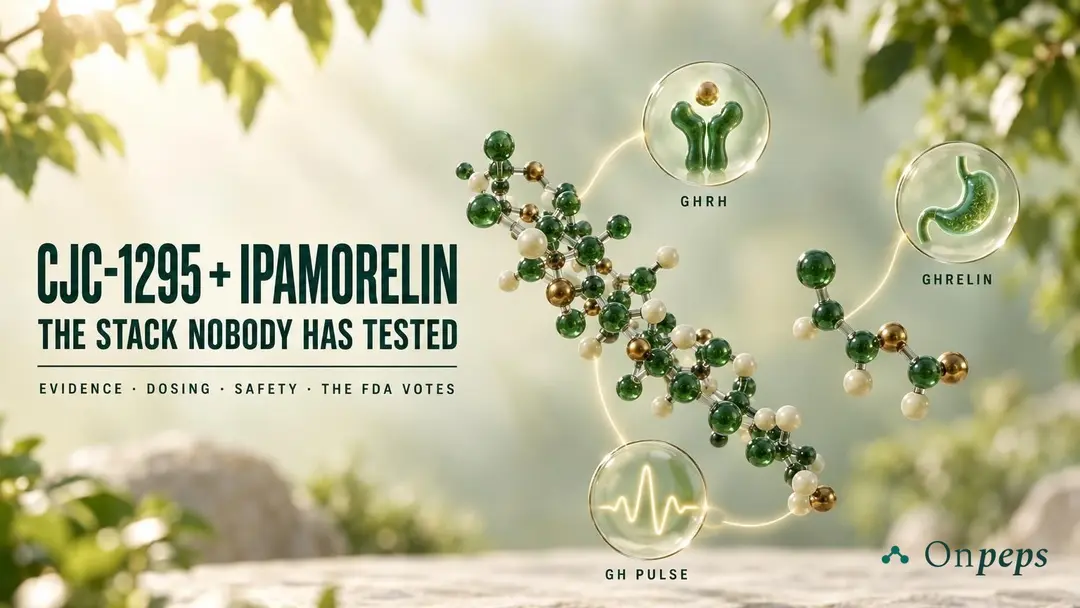
CJC-1295 is the GHRH half. ConjuChem took the first 29 amino acids of GHRH, swapped four of them so enzymes would stop chopping it up within minutes, then bolted on a reactive group that binds the peptide permanently to albumin in the blood. That group is the “drug affinity complex” (DAC), giving the compound a half-life of 5.8 to 8.1 days. The version sold for stacking with ipamorelin is the same fragment without the DAC — short-acting, and never studied in humans.
Ipamorelin is the ghrelin half. Novo Nordisk built it in the late 1990s as a five-residue compound that kept the potency of older GHRPs and lost their side effects. In pigs, it released growth hormone at 200 times the effective dose without touching ACTH, cortisol, or prolactin.
How the pituitary releases growth hormone
Your pituitary releases growth hormone in pulses, mostly at night. Two signals turn the tap on: GHRH comes down from the hypothalamus and acts on the GHRH receptor; ghrelin comes up from the stomach and acts on a separate receptor, GHS-R1a. A third signal, somatostatin, turns the tap off. The stack is built to push both “on” buttons at once.
Why it is trending now
Three things explain the search curve. First, regulatory whiplash: in April 2026, HHS Secretary Kennedy announced twelve peptides were coming off the FDA’s Category 2 list, and many read that as “peptides are legal now” — but CJC-1295 and ipamorelin were not on the list. Second, clinics: “CJC/Ipa” is the default growth-hormone offer at telehealth and longevity practices. Third, medicine is catching up with the market: a 2026 review in Frontiers in Endocrinology catalogued online protocols for CJC-1295, ipamorelin, and their relatives, and set out a triage framework for doctors.
Conclusion
The stack has a tidy pharmacological story: two molecules, two receptors, one bigger growth-hormone pulse. But a tidy story is not human evidence. Understanding its mechanism and evidence boundaries is the first step toward a rational view.